The heart has its own unique electrical system. Its function is to synchronise the contractions effectively.
An electrical system managed by a conductor
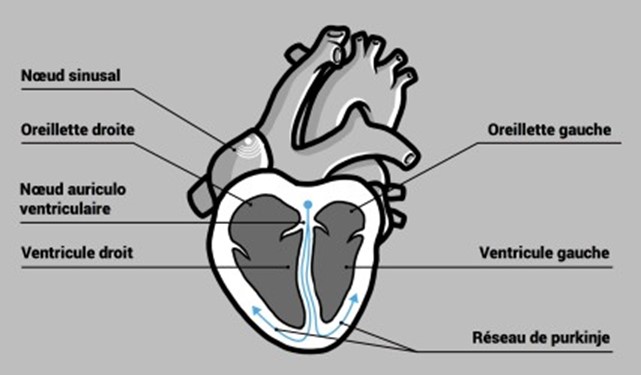
The leader of the electrical heart system is situated at the top of the heart, in the right atrium.
A cluster of cells called sino-atrial node is in fact the natural pacemaker for the heart. This node is responsible for all heartbeats as well as the frequency, or rate.
An organised electrical transmission
The electricity generated is transmitted to the atriaThe atria are two of the four cavities of the heart. There is a right atrium and a left atrium. They are like reservoirs for the right and left ventricules. following different steps of the electrical system; the electrical customs and the rapid conduction network in the ventricles.
The heart is not always as regular as clockwork.
The extrasystoles
As the prefix “extra” in their name indicates, extrasystoles are additional heartbeats that occur prematurely, meaning before the normal heartbeat.
The electrical system can be overexcited. The extrasystoles are supplementary heartbeats, either extras or premature, or before their time, pulses.
The extrasystoles may be a consequence of an overexcited system at the atrium and/or ventricle levels.
Almost everybody has them
The heart can skip a beat or pump once too many hence the word “extrasystole”. This is normal. In fact, it occurs in practically everybody, every day, without any appearance of symptoms.
Diverses descriptions de ces palpitations ont été émises
The palpitations may vary from one person to the other… Here are examples of the sensations that can be felt:
The heart stops and restarts
The heart sighs
The heart pumps for nothing
The heart goes on a roll
The heart skips some beats
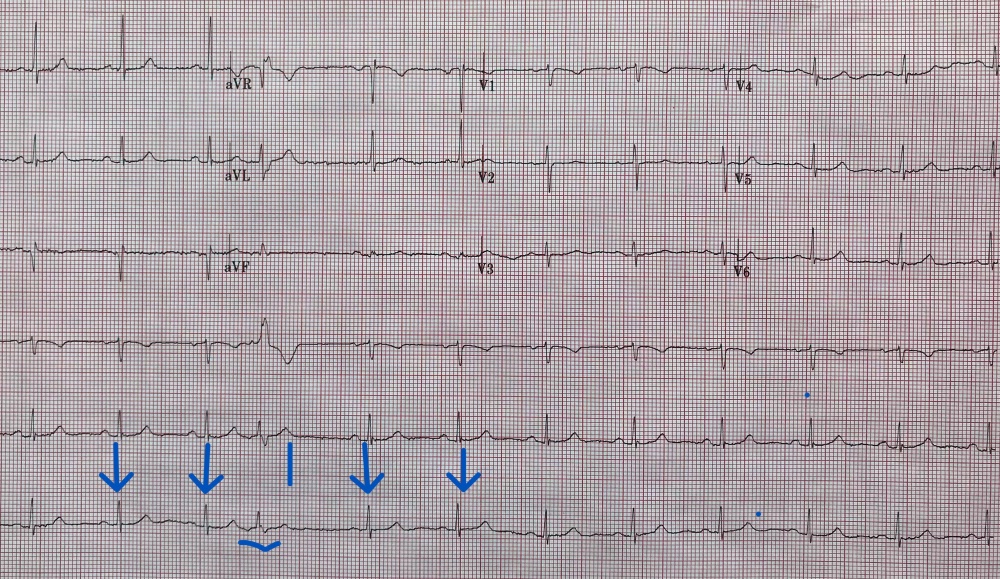
The electrocardiogram shows this:
Other possible symptoms
A short thoracic pain or streak of lightning may be perceived.
Most often, these symptoms are benign and will disappear, or at the very least, tolerated.
Certain stimulants increase the extrasystoles
The heart irregularities may be amplified by certain stimulants like coffee, some types of medication or illegal drugs, or simply stress and fatigue.
Palpitations felt at different moments of the day
Often, there are few associated symptoms.
Certain individuals are more sensitive to the heart rhythm irregularities. They can suffer from annoying symptoms they often describe as palpitations. These symptoms can vary during the day. They are often felt after eating or at bedtime.
Better noticeable in calm moments
Extrasystoles happen at any different moments throughout the day. They are simply better noticeable in calmer periods of the day.
A certain variation
Extrasystole palpitations vary throughout the day, but may also vary over the course of a year. Some people show more symptoms in a given season and less in another.
Taking your pulse helps the doctor
You can perceive extrasystoles while taking your pulse. This can be done on your wrist or your neck.
Recognizing and describing your pulse during palpitation periods is of great help for your doctor.
Usually, the pulse is rhythmic. A small beat followed by a long pause before the next pulsation is a typical situation.
Another common example is a series of 2 or 3 rapid, close pulsations then back to a regular beat.
Taking your pulse may help clarify if the heart is really the cause of these palpitations. In the event that the pulse is regular during palpitation moments, this would be a sign that the heart is not the source of the problem.
Possible tests
The health professional can verify the frequency and the location of the extrasystoles in the atriums and/or in the ventricles using a holter.
He can also demand an echocardiogram to take a look at the heart’s structure.
A disappointing therapy
A therapy to eliminate extrasystoles is rarely prescribed. It has secondary effects and do not solve all the palpitations.